Airfield Defense
Screen concepts for aircraft ramps, runways, tankers, AWACS, and expeditionary air operations. See also: Base Defense →
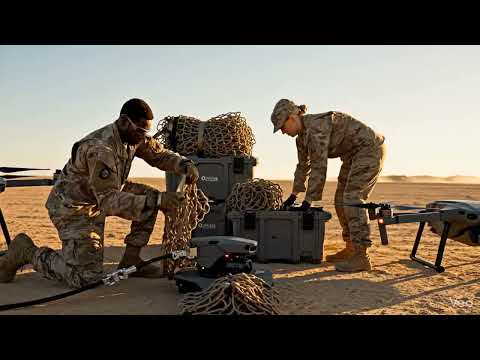
KINS deploys large-scale aerial barrier nets from commercial drone platforms — physically blocking loitering munitions, cruise missiles, and attack drones. No warhead. No guided munition. No fixed infrastructure required.
KINS is not a replacement for existing air defense. It is an affordable additional layer — designed to absorb high-volume, low-cost threat saturation and preserve high-value interceptors for the threats that demand them. Explore the full cost analysis →
Cheap drone interceptors have improved the Shahed interception problem. Cruise missiles remain a harder challenge — and the cost-exchange ratio does not scale at existing interceptor prices.
KINS defeats Shahed-class loitering munitions and cruise missiles without bullets or explosions — and the platform recovers intact for redeployment. This is a new layer, not a replacement for what already exists.
The animation below illustrates the KINS aerial interception geometry as a representative concept visualization.
The same core capability — aerial barrier nets deployed from drone platforms — addresses multiple distinct mission profiles across land, sea, and air domains.
Deployable screens for naval vessels, ports, littoral operations, and expeditionary maritime assets.
Protection concepts for aircraft, fuel infrastructure, command centers, and logistics hubs across all service branches.
Screen concepts for aircraft ramps, runways, tankers, AWACS, and expeditionary air operations. See also: Base Defense →
Defense applications for power, communications, logistics, and strategic infrastructure nodes.
Technical documentation and partnership terms are available under NDA to defense contractors, system integrators, and government acquisition representatives.
Provisional Patent Filed · SAM.gov Registered · UEI: M9VBXA3DH8R5 · CAGE: 20K82